Hi there,
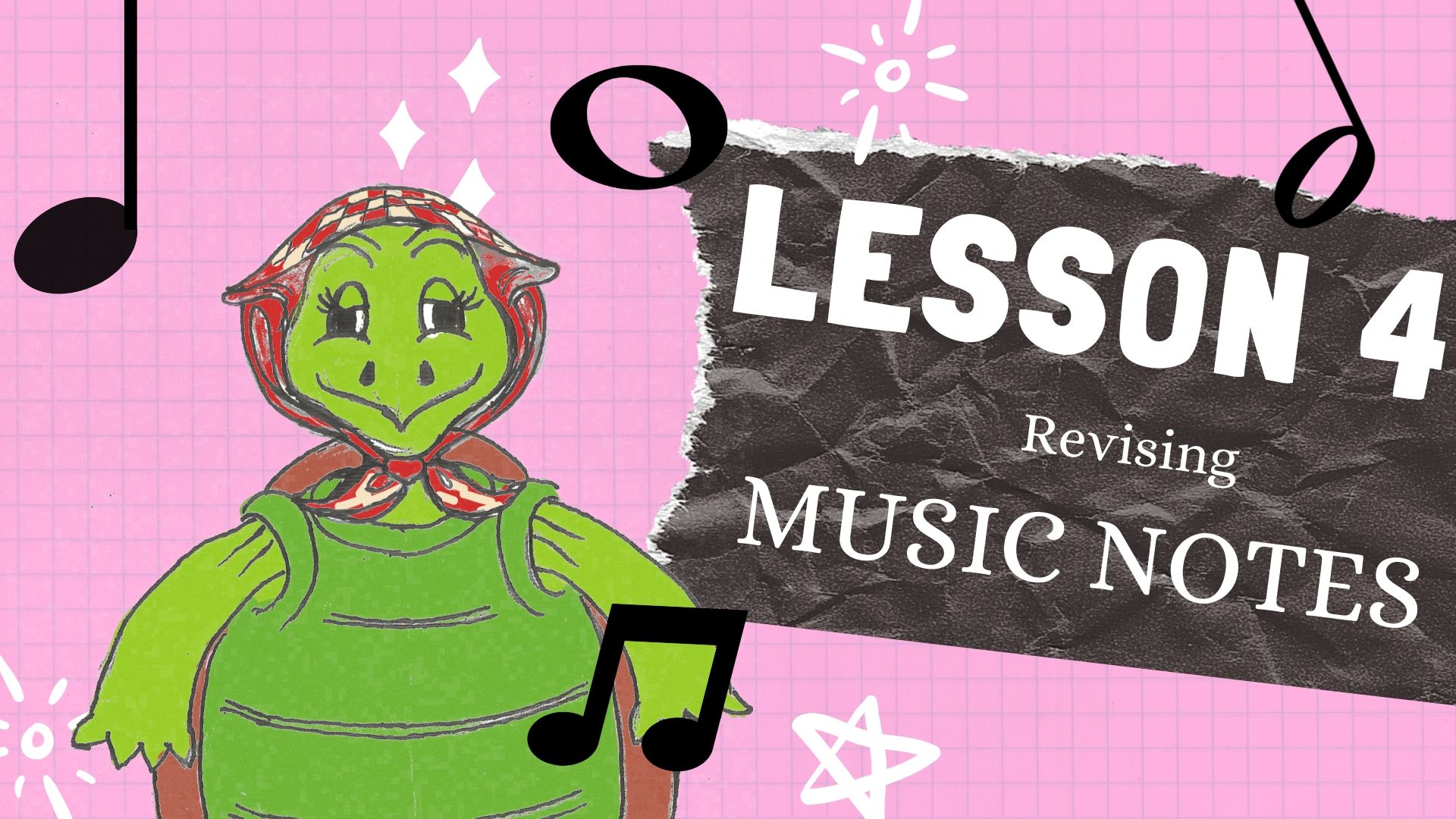
join me today in exploring how to use the EMW Beginner Recorder Lesson 4 on YouTube to teach kids (or adult beginner musicians who enjoy a few extra pictures and a bit of whimsy…) the basic note values and how they compare in duration.
This lesson is based on, and works in conjunction with, the YouTube video Beginner Recorder Lesson 4.
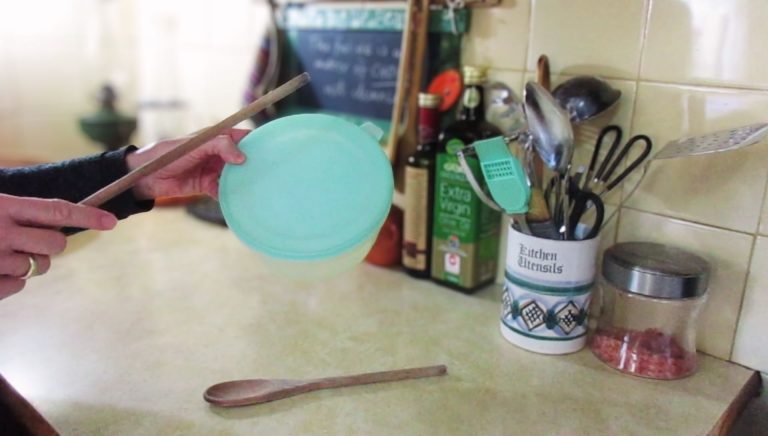
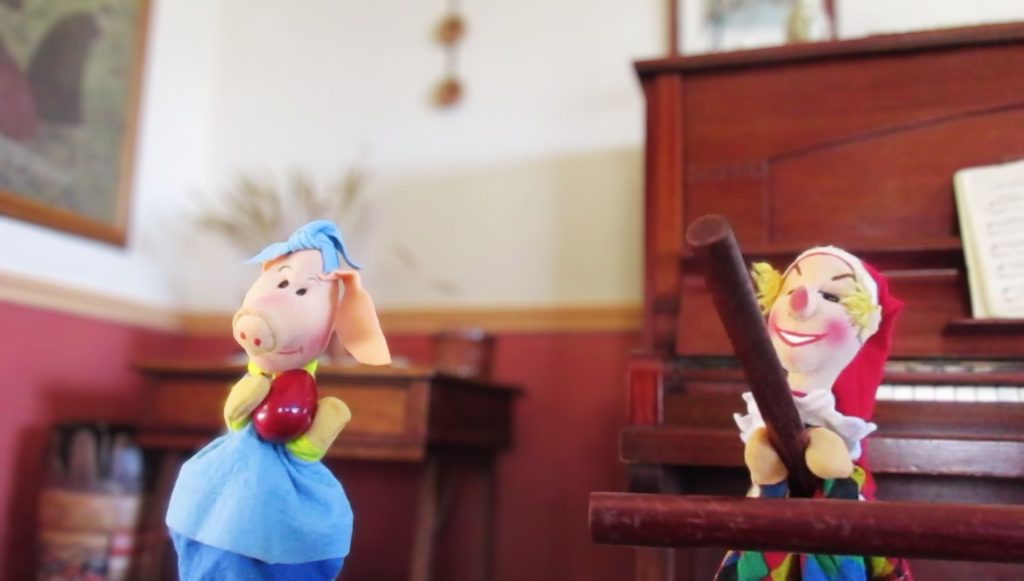
In this lesson Miss Piggy and Kasper, the assistants, compare note values on rhythmic percussion instruments and not only on the recorder. If you do not have such instruments available, then you will find some alternative suggestions in the video (at 9:08), for example, using wooden spoons as rhythm sticks, or a small container filled with rice as an egg shake (shaker).
HOW TO USE THE EMW BEGINNER RECORDER LESSON 4 VIDEO:
Start the lesson by watching the beginning of the video with your kids. After having watched Miss Piggy and Kasper having fun comparing note values on the percussion instruments, pause the video (at 9:50) and give your young students an opportunity to do the same.
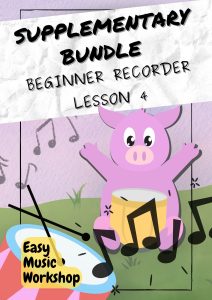
For this purpose I have made a worksheet which can be cut into strips so that the students, or groups of students, can choose one to play at the same time in order to compare the length of the different note values. Each strip has a recommended rhythmic percussion instrument. The students can then swap strips and instruments in order to experience all the instruments and note values. This worksheet is available in the SUPPLEMENTARY BUNDLE FOR LESSON 4.
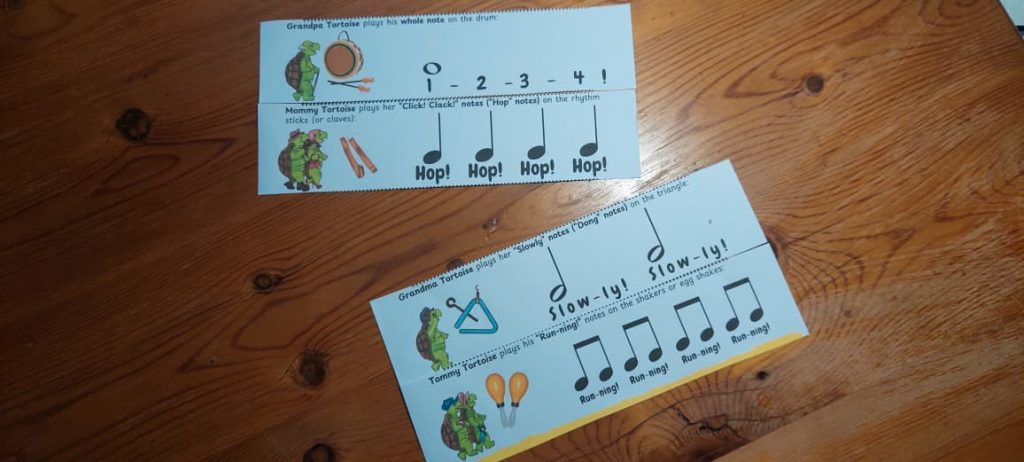
For some extra fun, the learners can cut out the finger puppets of Mommy Tortoise, Tommy Tortoise, Granny Tortoise and Grandpa Tortoise to compare the note values by comparing their steps as seen in the video of LESSON 4. It will be easier to use one puppet per person. Let each family member compare its steps to the other family members. For example, Mommy Tortoise will only walk with her “Click! Clack!” steps next to Granny Tortoise, who only walks with a “Step-swing!”. The students should notice that Mommy always takes two steps for every step that Granny Tortoise takes. This activity would be an extension of the above Note Value Quiz.
After this activity, continue to watch the rest of the video. This next part shows how to “build” a melody by using the different note values and adding the fingering learnt so far on the recorder. Give the music students an opportunity to play this newly written melody by pausing the video and letting them read and play the notes of the finished piece. There is a link below the YouTube video to a free copy of the melody for printing and practising (This free melody is also included in the SUPPLEMENTARY BUNDLE for convenience).
Here is a summary in point form of the above lesson:
- Begin the lesson by watching the start of the video with the students.
- Let students observe Miss Piggy and Kasper comparing note values using percussion instruments, then pause the video at 9:50.
- Provide a worksheet to be cut into strips, each showing a note value and a suggested percussion instrument. (Worksheet available in the SUPPLEMENTARY BUNDLE FOR LESSON 4…)
- Have individual students or groups choose a strip, place two of strips above one another and play these two strips at the same time to compare note lengths.
- Allow students to swap strips and instruments so they experience all note values and instruments.
- Continue watching the rest of the video (from 9:50).
- Pause the video to let the students play the newly “built” piece from the screen. Finish watching.
- Print a copy for them to take home and practise (A free copy available in a link below the video.)
A FOLLOW-UP LESSON:
The video for LESSON 4 ended with the teacher showing how to build a melody using the
learnt note values and fingering, and then playing and practising this new piece.
In this follow-up lesson the students get the opportunity to change the melody of this same piece by changing only the fingering of the given notes in any which way they want, with the exception of the last note, thereby creating their own melody. The worksheet for this activity has been included in the SUPPLEMENTARY BUNDLE FOR LESSON 4.
The reason why the fingering of the last note has been given is because for this melody
ending on three fingers (and the thumb) makes it sound as if the end has been reached, that
is, it sounds complete and doesn’t “hang in the air”.
This activity gives the students the opportunity to be creative and to take the first steps towards “composing” their own melodies.
In this follow-up lesson, note value comparisons can also be revised by looking at and discussing the note value comparison poster with the tortoise family, and using it to do a short theory exercise or quiz. Both have been included in the SUPPLEMENTARY BUNDLE FOR LESSON 4. On the quiz sheet the students are asked to compare the number of notes being played by Miss Piggy and Kasper, and they need to write in the music notes for their answers. This also gives them an opportunity to practise their newly acquired skill of writing music notes. (See SUPPLEMENTARY BUNDLE FOR LESSON 3)
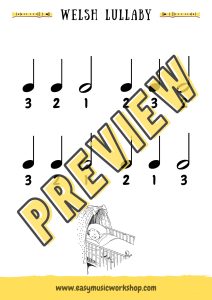
To end off the lesson they can learn to play a new little simplified melody out of the Welsh lullaby “Suo Gan”, also available in the SUPPLEMENTARY BUNDLE FOR LESSON 4. To put it into context, let them listen to the whole lullaby. A beautiful version is sung by the Welsh boy soprano Cai Thomas in a video on YouTube >> here <<. It is a folk song from Wales and was likely passed down orally before it was documented by the Welsh folklorist Robert Bryan and printed in the early 1800s. The kids always enjoy a good video. Some background information about the piece they are playing makes the piece more meaningful. You could also check if the young students know what a lullaby is. “Suo Gan” translates into “lull song”.
Here is a summary in point form of the above lesson:
- Introduce the follow-up lesson by telling the students that they will now write their own melody for the piece introduced at the end of the video for LESSON 4, “Our First Song”, into “My First Song” with the help of the worksheet (The worksheet is provided in the SUPPLEMENTARY BUNDLE FOR LESSON 4).
- Instruct students to alter only the fingering of the given notes, keeping the last note unchanged because it creates a complete, finished-sounding ending.
- The students play their own melody on their recorder.
- Revise and compare note values using the tortoise family note value poster (…also available in the SUPPLEMENTARY BUNDLE FOR LESSON 4).
- Use the note value poster for a short theory exercise from the SUPPLEMENTARY BUNDLE FOR LESSON 4 in which students compare the number of notes played by Miss Piggy and Kasper on the quiz sheet and write in the correct music notes for their answers.
- Play the video of the full lullaby of “Suo Gan” so students can hear the piece in context.
- Conclude the lesson by teaching a simplified melody from the Welsh lullaby “Suo Gan”, found in the SUPPLEMENTARY BUNDLE FOR LESSON 4.
So these are possible activities linked to the EMW BEGINNER RECORDER LESSON 4, which help to revise and internalise the content and skills learnt in this lesson.
I hope these activitices bring you and your students joy in music-making.
Kind Regards
Elisabeth